
RJW Electrical
Is PAT testing legally required in a domestic property?
No, PAT testing is not generally a legal requirement in an owner-occupied domestic property, and UK law does not specifically require landlords to carry out PAT testing on portable appliances. However, landlords must ensure any electrical appliances they provide are safe to use, so inspection and testing may be a sensible way to identify defects and demonstrate that reasonable safety checks have been made.
PAT testing is not a standalone legal test that every domestic property must undergo. UK electrical safety law generally focuses on whether electrical equipment is safe in use, rather than requiring a particular portable appliance testing procedure, certificate or testing interval for every home.
For an owner-occupied home, the decision to arrange PAT testing is normally a matter of risk management. The person responsible should still take reasonable steps to prevent electrical equipment from causing electric shock, burns or fire. That includes checking appliances, plugs, cables and sockets for visible damage, following the manufacturer’s instructions and taking defective equipment out of use.
The position is different when a property is rented or appliances are supplied to other people. A landlord or letting provider should be able to show that appliances supplied with the property are safe and properly maintained. A formal PAT test can provide useful evidence of inspection, particularly where a furnished property contains several appliances or where equipment is used frequently. It is not, however, a substitute for repairing or replacing unsafe equipment.
In England, the electrical safety regulations applying to private rented properties primarily concern the fixed electrical installation and the inspection report for that installation. They do not create a universal PAT-testing timetable for portable appliances. Separate housing, licensing or occupancy requirements may apply in some properties, including certain houses in multiple occupation. Local authority licensing conditions can also impose additional electrical safety requirements.
Rules are not identical across every part of the UK. Requirements affecting rented accommodation, licensing and electrical inspections can vary between England, Wales, Scotland and Northern Ireland. A landlord should therefore check the rules applying to the property's location, tenancy type and licence conditions rather than relying on a general PAT-testing interval.
PAT testing can be particularly appropriate where:
- the property is furnished and appliances are supplied by the landlord;
- appliances are moved regularly, transported between properties or used in demanding conditions;
- equipment is used by tenants, guests, carers, cleaners or other people who did not purchase it;
- there is a history of damage, overheating, nuisance tripping or electrical faults;
- the property forms part of a licensed or managed accommodation arrangement; or
- an insurer, managing agent, contract or licence condition asks for documented appliance checks.
A competent inspection normally combines a visual assessment with electrical tests selected for the type of appliance. The tester may examine the plug, flex, casing, strain relief and signs of overheating before deciding whether an electrical test is suitable. Not every appliance should automatically be tested in the same way, and some equipment may require particular precautions or manufacturer-specific instructions.
There is no single legally prescribed testing interval that applies to every domestic appliance. The sensible frequency depends on the equipment, its age and condition, how often it is used, whether it is moved, and the environment in which it operates. A visual check should be carried out more frequently than any formal test, with faults dealt with immediately rather than waiting for the next planned inspection.
A PAT certificate or test record can document what was examined, the equipment identification, the result and any remedial action. It demonstrates that a check was undertaken on a particular date, but it does not prove that an appliance remains safe indefinitely or cover defects that develop afterwards. Records should be kept alongside repair information, purchase details and evidence of any fixed-installation inspection where relevant.
Portable appliances should also be distinguished from fixed electrical installations. A PAT inspection is concerned with appliances that can be moved or connected and disconnected from a supply. Consumer units, wiring, sockets and permanently connected equipment fall within electrical installation inspection and testing, which is a separate matter.
In practical terms, a domestic property does not automatically need a PAT certificate simply because it contains electrical appliances. The stronger question is who supplied the equipment, who is responsible for its condition, how it is being used and whether another legal, contractual or licensing requirement applies. Where the risk is unclear, a suitably competent electrical professional can advise on the appropriate inspection and testing arrangements.
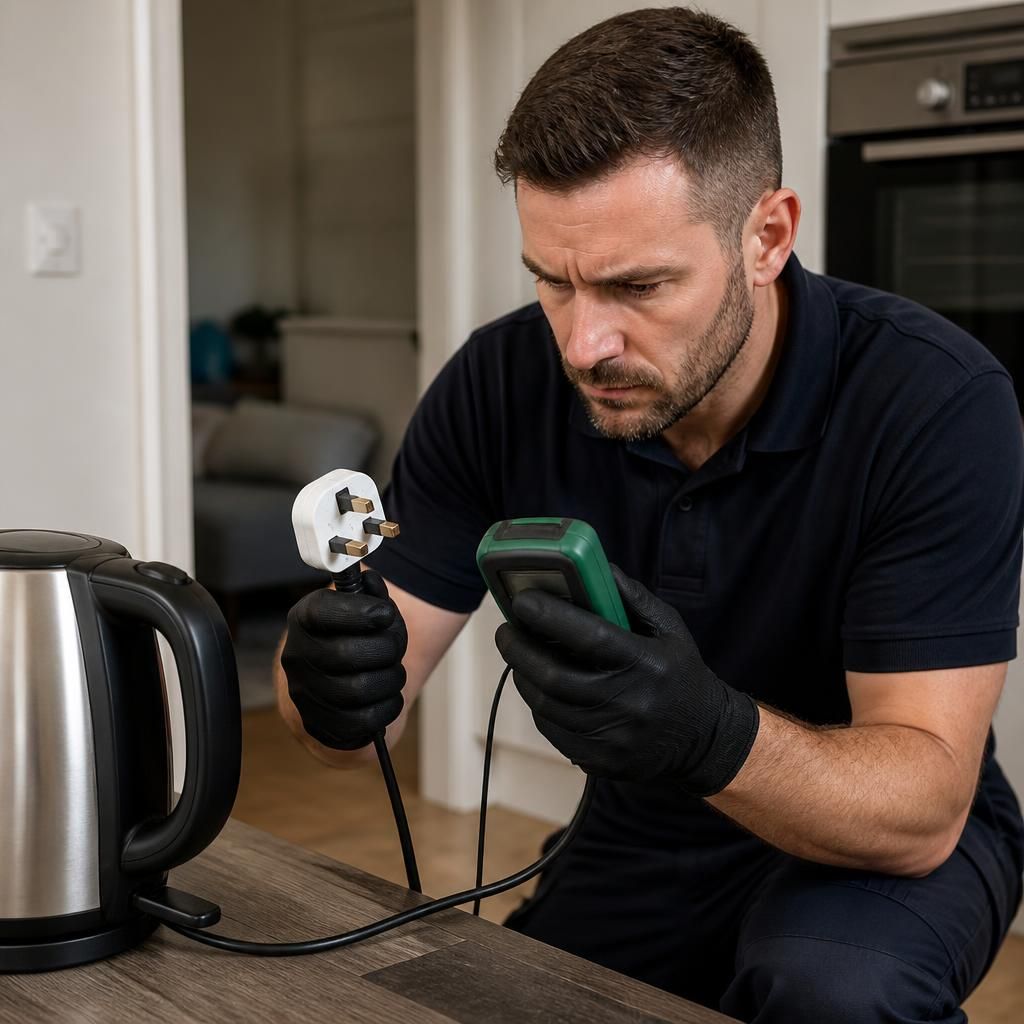
The legal position can change when a domestic property is also used for work. Appliances used by an employer, employee, cleaner, carer or home-based business may fall within workplace health and safety responsibilities, even if they are located in a house or flat. In that situation, the relevant organisation should assess the equipment, its users and the working environment, then decide whether inspection or testing is necessary.
This does not mean every appliance in a home automatically requires a PAT test. The important distinction is whether the equipment is being used as part of work and who controls or provides it. A separate risk assessment may therefore be appropriate for home offices, workrooms, rental businesses or equipment supplied for paid services.
Need advice on domestic PAT testing?
If you are unsure whether your appliances require professional inspection, contact RJW Electrical for practical advice based on how the property and equipment are used. You can also request a no-call-out-fee quote for domestic PAT testing where a formal inspection is appropriate.