
RJW Electrical
What do C1, C2 and C3 mean on a domestic EICR?
The codes on a domestic EICR are risk classifications assigned to observations found during the inspection and testing. They indicate the seriousness of an issue, the action it may require and whether the overall report can be recorded as satisfactory.
C1 – danger present
A C1 observation means the inspector has identified an immediate risk of injury. The danger may arise from accessible live parts, exposed conductors, damaged equipment or another condition where contact, fire or electric shock could occur without adequate protection.
Where a C1 is found, the immediate priority is to make the situation safe. This may involve isolating the affected circuit or equipment, restricting access, removing the hazard or carrying out an urgent repair. A C1 is not simply a note for future improvement: it indicates that the condition requires prompt attention.
C2 – potentially dangerous
A C2 observation identifies a defect that could create danger, although the risk may depend on a fault occurring or on someone coming into contact with the affected installation. Examples can include inadequate protective measures, serious deterioration, unsuitable equipment or a fault that could lead to electric shock or overheating.
The inspector will normally recommend remedial work for a C2. The exact solution depends on the defect, the circuit design and the surrounding installation. It may be possible to repair or replace one item, but some observations require further testing to establish the full extent of the problem.
C3 – improvement recommended
A C3 observation records a condition that does not meet the preferred current standard but is not considered to present a danger under the conditions assessed. It is an advisory recommendation rather than an immediate safety failure.
Electrical standards develop over time, so an older installation is not automatically defective simply because it does not include every feature expected in a new installation. A C3 may therefore identify an opportunity to improve safety, functionality or compliance with current practice without requiring the installation to be upgraded in full.
Examples might include an installation feature that could be enhanced during future work, or an item where additional protection would be beneficial but the inspector has not judged its absence to represent an immediate or potentially dangerous defect. The observation should still be read carefully, because the report will explain what improvement is being recommended.
How the codes affect the EICR result
An EICR with only C3 observations can generally be recorded as satisfactory. A C3 does not, on its own, make the report unsatisfactory. By contrast, a report containing a C1 or C2 observation is unsatisfactory because the installation includes a condition requiring remedial attention.
An inspector may also use the code FI where further investigation is necessary before the condition can be assessed properly. FI is not the same as C3. It means that the available inspection or test information is insufficient to reach a reliable conclusion, and the further investigation may subsequently identify a C1, C2, C3 or no code at all.
Why the same fault may receive different codes
Codes are assigned to the condition found at the time of inspection, rather than to a particular component in isolation. The inspector considers factors such as accessibility, the likelihood of contact, the effectiveness of protective devices, the condition of the equipment, the environment and the possible consequences of failure.
For example, damage to an electrical accessory in a dry, protected location may be assessed differently from similar damage in an area where moisture or physical contact is likely. The report should state the observation and the relevant location so that the recommended action can be understood and prioritised.
What to do after receiving the report
- Read the observation details and locations, not just the summary outcome.
- Deal with any C1 condition as a priority and follow any safety advice given by the inspector.
- Arrange assessment and remedial work for C2 observations from a suitably qualified electrician.
- Discuss C3 recommendations when planning alterations, refurbishment or other electrical work.
- Ask for an explanation if an observation is unclear or if the suggested work appears broader than the wording of the report.
An EICR identifies the condition of the installation at the time of inspection; it is not, by itself, a record that remedial work has been completed. After repairs, the electrician should provide suitable documentation for the work undertaken, such as appropriate test results or an electrical certificate, depending on the nature and extent of the work. If significant defects have been addressed, a further inspection or confirmation of satisfactory condition may be needed.
The most useful way to interpret C1, C2 and C3 is therefore to consider both the code and the full observation. The code indicates the level of concern, while the wording explains what was found, where it was found and what action is appropriate.
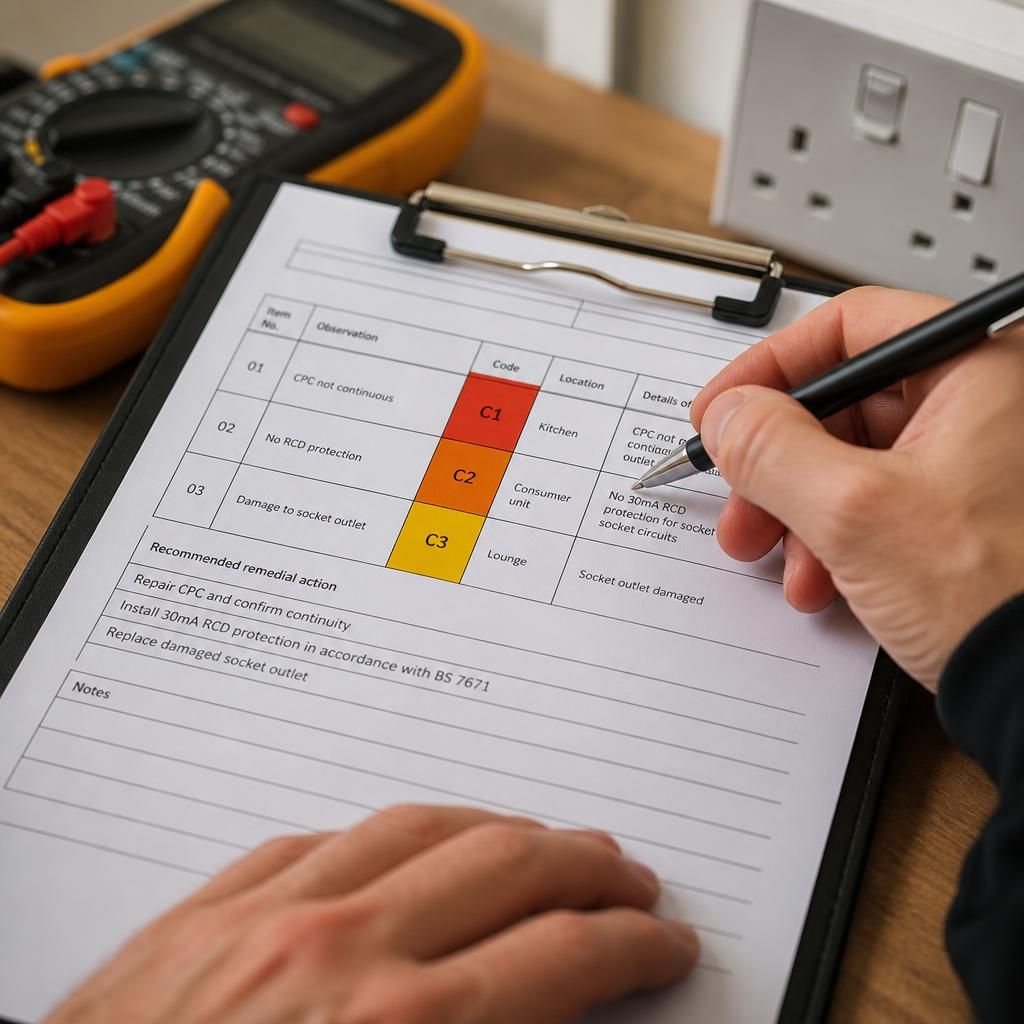
A C1 or C2 on a domestic EICR does not necessarily mean that every circuit or electrical fitting in the property is unsafe. The code applies to the specific observation recorded, such as a particular socket, circuit, cable or protective measure. The report should identify its location and explain the associated risk, allowing remedial work to be focused on the affected part of the installation. The overall EICR may be unsatisfactory until the relevant defect is addressed, but the coded observation should not be interpreted as a blanket assessment that the entire electrical system must be replaced.
Need help interpreting your domestic EICR?
If you are unsure what action your EICR observations require, ask RJW Electrical to review the report and explain the recommended next steps. You can then request a no-call-out-fee quote for any remedial work identified.