
RJW Electrical
How is phase balancing managed in a three-phase installation?
Phase balancing in a three-phase installation is managed by distributing single-phase circuits and loads as evenly as practical across the three phases. An electrician assesses the connected and measured loads, rearranges circuits where necessary, and verifies phase currents, neutral loading and voltage conditions through testing.
The objective of phase balancing is not to make the three phase currents identical at every moment. It is to keep the installation within its design limits by managing how demand is distributed, while allowing for equipment that operates intermittently and loads that naturally vary during the day.
Establishing the installation’s load profile
The process starts with the distribution arrangement, circuit schedule and connected equipment being reviewed together. This identifies which circuits are single-phase, which items use all three phases, and which loads operate continuously, intermittently or only under particular conditions. Motors, heaters, lighting, office equipment, catering equipment and charging equipment can all have different operating patterns, so the largest connected load is not necessarily the most important factor when deciding where a circuit should be placed.
Design calculations consider the expected maximum demand rather than simply adding every appliance rating together. Appropriate diversity may be applied where loads are unlikely to operate simultaneously, but essential or regularly used equipment must still be allowed for. The available capacity of the main switchgear, distribution board, cables and protective devices also limits what can be allocated to each phase.
Measuring actual conditions
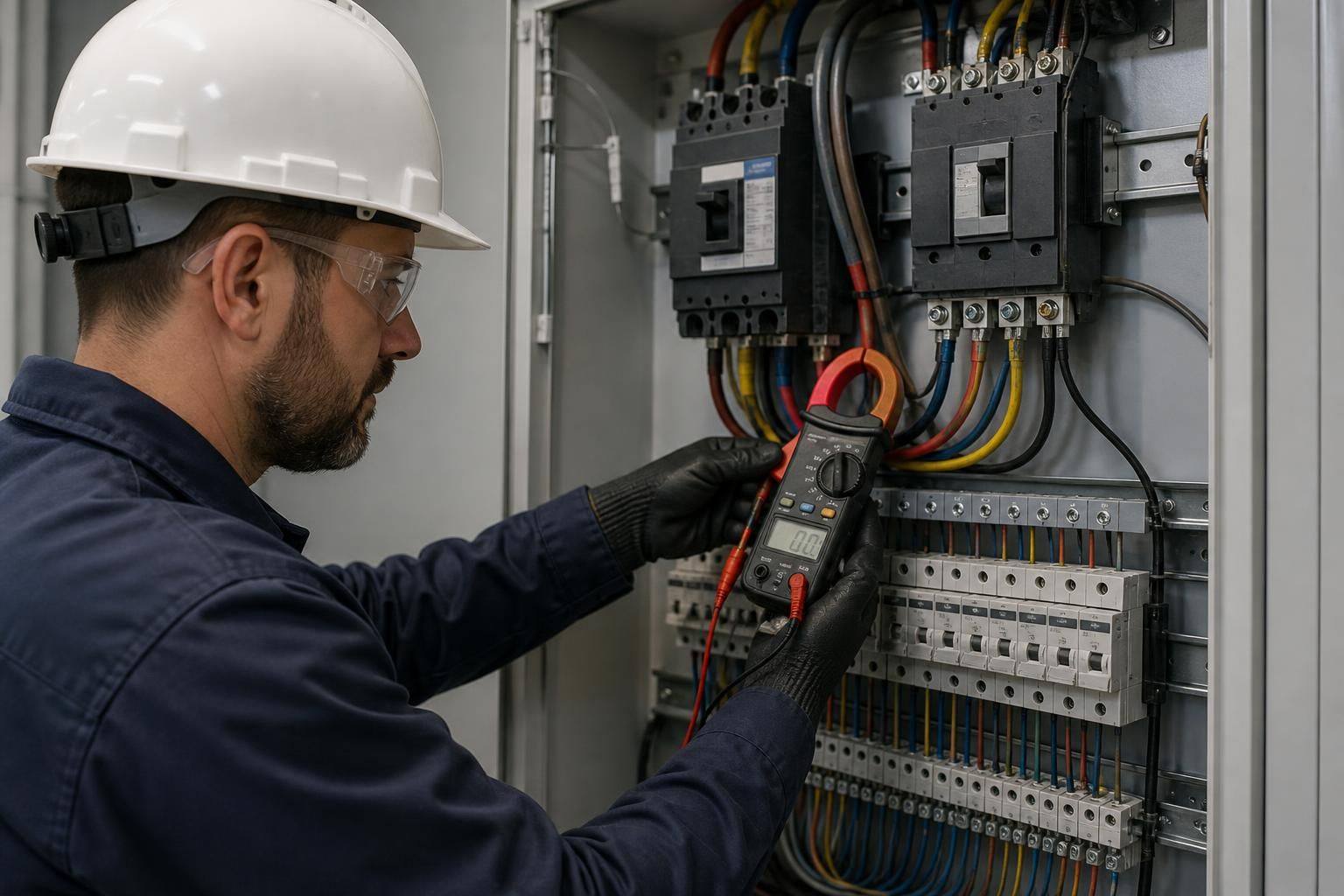
Calculated demand is checked against measured performance. An electrician can use suitable test instruments to record phase currents, line-to-line and line-to-neutral voltages, neutral current and, where relevant, power factor. Measurements are more useful when taken while the installation is operating under representative conditions; a reading taken with most equipment switched off may not reveal the imbalance that occurs during normal production or occupancy.
Several readings may be needed because a building can have different load patterns at different times. Starting currents from motors, thermostatically controlled equipment and switched-mode power supplies can also affect the results. Where electronic equipment is present, harmonic currents should be considered separately. A system may appear reasonably balanced on its fundamental current while still placing additional demand on the neutral or producing unwanted heating because of harmonics.
Reallocating single-phase circuits
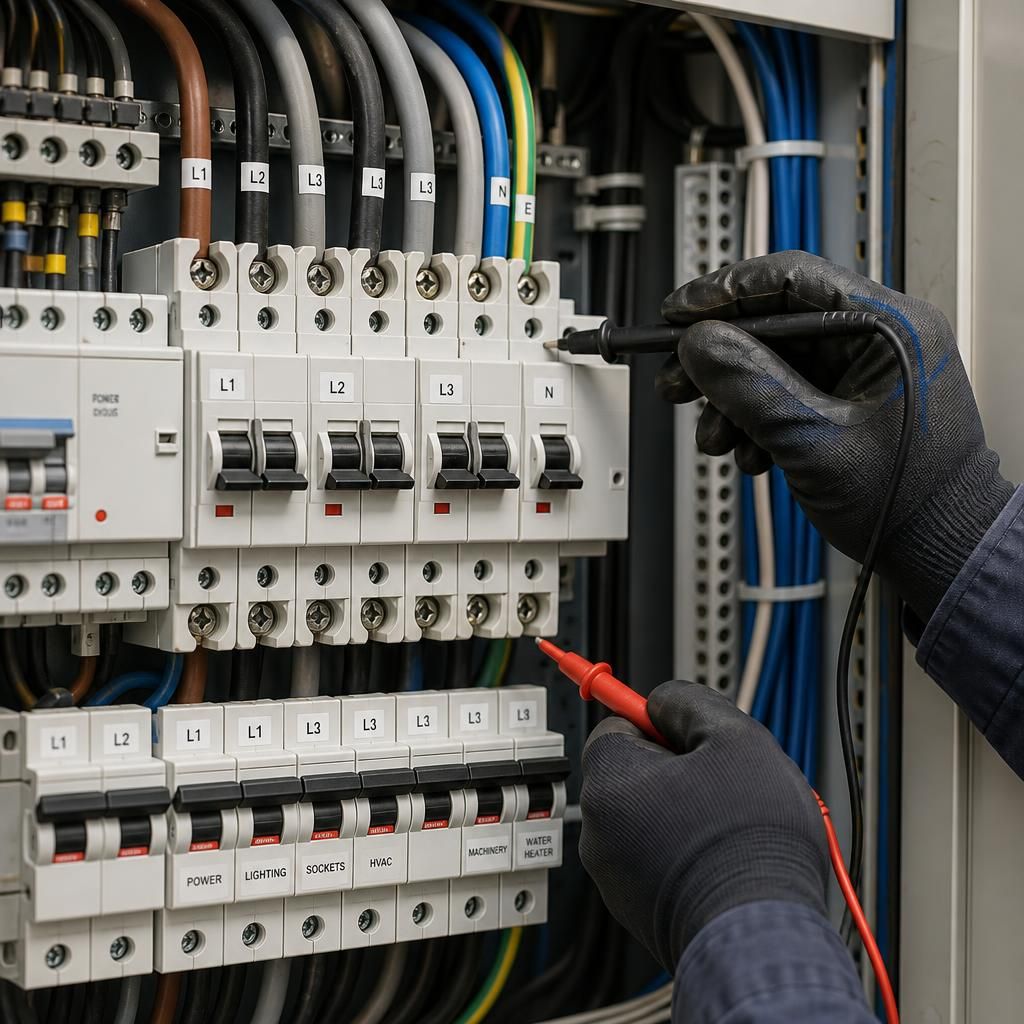
Where the measurements and design review identify an unsuitable distribution, selected single-phase circuits can be moved to another phase. This work is carried out at the distribution board with the supply isolated and the conductors, protective devices and circuit identification checked. Circuits are not allocated by a simple rule such as placing one large load on each phase. The electrician considers the combined effect of fixed loads, diversity, future use and the physical arrangement of the board.
Reallocation must preserve correct protective-device operation and circuit segregation. Labels, schedules and phase identification need to be updated so that future inspection or maintenance does not rely on assumptions. If a circuit is transferred without checking its cable, neutral, protective device or termination, the apparent improvement in phase current may introduce a different safety or compliance issue.
Three-phase equipment and the neutral
Equipment connected across all three phases, such as many motors and larger plant items, is not balanced by moving it from one phase to another. Its operation depends on correct phase sequence, suitable voltage, sound connections and the condition of all three phase conductors. A missing phase, incorrect rotation or poor termination can cause faults even when the overall current readings look acceptable.
Single-phase loads normally return current through the neutral. When their fundamental currents are reasonably distributed, the neutral current is reduced because the phase currents partially cancel. That does not mean the neutral can be disregarded: unbalanced loading, harmonic-producing equipment, loose terminations or an incorrectly sized conductor can all create problems. Neutral current is therefore included in a proper assessment rather than inferred from the phase readings alone.
Verification after changes
After any rearrangement, testing confirms that the phase sequence, voltage, continuity, insulation, polarity, earthing and protective measures remain satisfactory for the installation. Operating measurements are then repeated to compare the three phase currents and neutral loading with the original condition. Results should be recorded alongside the revised circuit schedule, including any limitations caused by variable loads or equipment that was not operating during the test.
Balancing may need to be reviewed when new machinery, lighting, heating, server equipment or vehicle charging equipment is added. If the supply itself has a voltage imbalance, the installation’s circuits are already suitably allocated, or harmonic currents are significant, moving circuits alone may not resolve the issue. Those conditions require further investigation of the supply, equipment characteristics, neutral arrangement and distribution design.
For domestic, commercial and industrial three-phase systems, RJW Electrical can assess the existing arrangement, interpret measured loading and identify practical corrective work where required. Any alterations should be designed, tested and documented by a suitably qualified electrician rather than made by trial and error.
Phase balancing also protects three-phase motors and other rotating equipment from the effects of unequal phase voltage. Even a relatively small voltage difference between phases can produce a disproportionately higher current in the negative-sequence component, increasing motor heating and reducing available operating margin. This is why balancing work considers voltage conditions at the equipment, not only the current shown at the distribution board.
A sound assessment therefore distinguishes between an imbalance caused by the way circuits are allocated and one originating in the incoming supply, cable voltage drop or a faulty connection. Reallocating single-phase circuits can address the first condition, but it will not correct a supply-side fault. Identifying the source prevents an apparent balancing adjustment from masking a developing problem elsewhere in the installation.
Need advice on phase balancing in a three-phase installation?
If you need phase loading assessed or a proposed alteration checked, contact RJW Electrical to discuss a suitable inspection and testing plan for your three-phase installation.