
RJW Electrical
How are electrical maintenance priorities assessed in a commercial building?
Commercial electrical maintenance priorities are assessed by considering the risk to people, compliance requirements, the condition of the installation, and the importance of affected equipment or systems to business operations. Immediate hazards and failures affecting critical services take precedence, followed by defects requiring planned remedial work and routine preventative maintenance.
Electrical maintenance priorities in a commercial building are assessed by combining the level of risk, the condition of the installation, the importance of the equipment supplied, and the evidence available from inspections, testing and fault reports. The assessment should identify what needs immediate attention, what can be scheduled as planned remedial work, and what can remain within routine preventative maintenance.
1. Establish the building’s electrical risk profile
The first step is to understand how the building is used and who may be affected by an electrical defect. A busy workplace, public-facing premises, industrial unit and multi-tenant building can each present different risks. The assessment considers factors such as:
- Whether staff, visitors, contractors or members of the public could come into contact with the affected equipment
- Whether work is carried out in damp, dusty, hot, corrosive or otherwise demanding conditions
- Whether portable equipment, machinery or temporary supplies place additional demands on the installation
- Whether restricted access, working at height or plant-room conditions increase the difficulty of safe inspection and repair
- Whether a defect could contribute to electric shock, burns, fire or damage to other equipment
An exposed live part, damaged enclosure, overheating connection or evidence of arcing would normally require a much higher priority than a minor non-safety defect. Temporary controls, such as isolating an unsafe circuit or restricting access, may be needed while permanent work is arranged.
2. Review inspection and testing evidence
Maintenance decisions should be based on more than a visual walk-round. Records from electrical installation condition reports, periodic inspection, testing, thermal checks, protective-device testing and previous repair work can show whether a problem is isolated or part of a developing pattern.
Useful evidence includes test results, recorded departures from expected readings, failed protective devices, loose or damaged accessories, signs of overheating, corrosion, moisture ingress and repeated circuit faults. Previous reports should also be checked to confirm whether recommended remedial work was completed or whether an item has remained outstanding.
Where documentation is incomplete, the lack of reliable records can itself increase the priority of an inspection. Without accurate circuit schedules, distribution-board information and maintenance history, it is more difficult to verify that the installation remains suitable for its present use.
3. Consider the importance of the affected system
Not every electrical defect has the same operational consequence. A fault affecting a non-essential socket may be managed differently from one affecting a server room supply, refrigeration system, production line, access-control system or life-safety installation.
Priority is influenced by what would happen if the equipment failed, including:
- Interruption to essential business processes
- Loss of heating, cooling, ventilation or refrigeration
- Interruption to communications, data processing or security systems
- Impact on fire detection, emergency lighting or other safety-related equipment
- Risk of damage to expensive plant or connected equipment
- Potential disruption to tenants, customers or other building users
Criticality should not be used to postpone a dangerous defect. It helps determine the order in which otherwise safe remedial tasks are planned, and whether additional measures such as temporary supply arrangements or controlled shutdowns are required.
4. Check compliance and design suitability
A building’s priorities are also shaped by its legal and technical obligations. The installation should be assessed against the Electricity at Work Regulations, relevant requirements for the building and the current edition of applicable wiring standards. This includes checking that protective measures, earthing and bonding, isolation, circuit identification and equipment selection remain appropriate.
Changes to the premises can alter the original risk assessment. New machinery, office layouts, additional appliances, electric vehicle charging equipment, air-conditioning systems or changes in occupancy may increase demand or introduce different environmental conditions. Maintenance planning should therefore identify not only defects, but also parts of the installation that are no longer suitable for the way the building is being used.
5. Assess the likelihood and consequences of failure
A practical priority assessment considers both how likely a failure is and how serious its consequences could be. Visible deterioration, repeated tripping, unusual smells, hot accessories, buzzing, flickering or unexplained equipment shutdowns may indicate a developing fault even when the circuit is still operating.
Conditions that increase concern include overloaded circuits, poor terminations, damaged cables, inadequate ventilation around equipment, water ingress and deterioration of distribution equipment. A defect that is currently intermittent should not automatically be treated as minor: repeated symptoms can indicate loose connections, insulation damage or a protective-device problem that may worsen without warning.
6. Separate urgent, planned and routine work
Once the evidence has been reviewed, findings can be grouped into clear action categories:
- Urgent work: conditions presenting an immediate danger or a serious risk of fire, electric shock, loss of protection or damage to critical equipment. The affected part may need to be isolated until it is made safe.
- Planned remedial work: defects that are not an immediate emergency but could worsen, reduce reliability or leave the installation unsuitable. These should be assigned an appropriate target and coordinated with the building’s activities.
- Routine preventative maintenance: inspection, cleaning, tightening where appropriate, functional checks and testing intended to identify deterioration before it becomes a failure.
- Monitoring: lower-risk observations that do not currently justify repair but should be recorded and reviewed during a later inspection or after a change in use.
The report should explain the reason for each priority rather than simply listing defects. Clear descriptions help a facilities manager decide whether work should be isolated, planned during a shutdown, coordinated with other contractors or escalated to the duty holder.
7. Reassess after changes or recurring faults
Priorities should be reviewed when the building layout, occupancy, equipment or operating processes change. They should also be reconsidered when the same circuit or item repeatedly fails after repair. Repeated faults may indicate that the underlying cause has not been addressed, such as an unsuitable load, poor ventilation, damaged cable or failing switchgear.
A suitably qualified electrical contractor can combine inspection findings, test results and information from building users to produce a documented maintenance plan. For commercial premises, that plan should link each action to the relevant circuit or asset, record the observed condition, state any immediate controls and confirm what further inspection or repair is required.
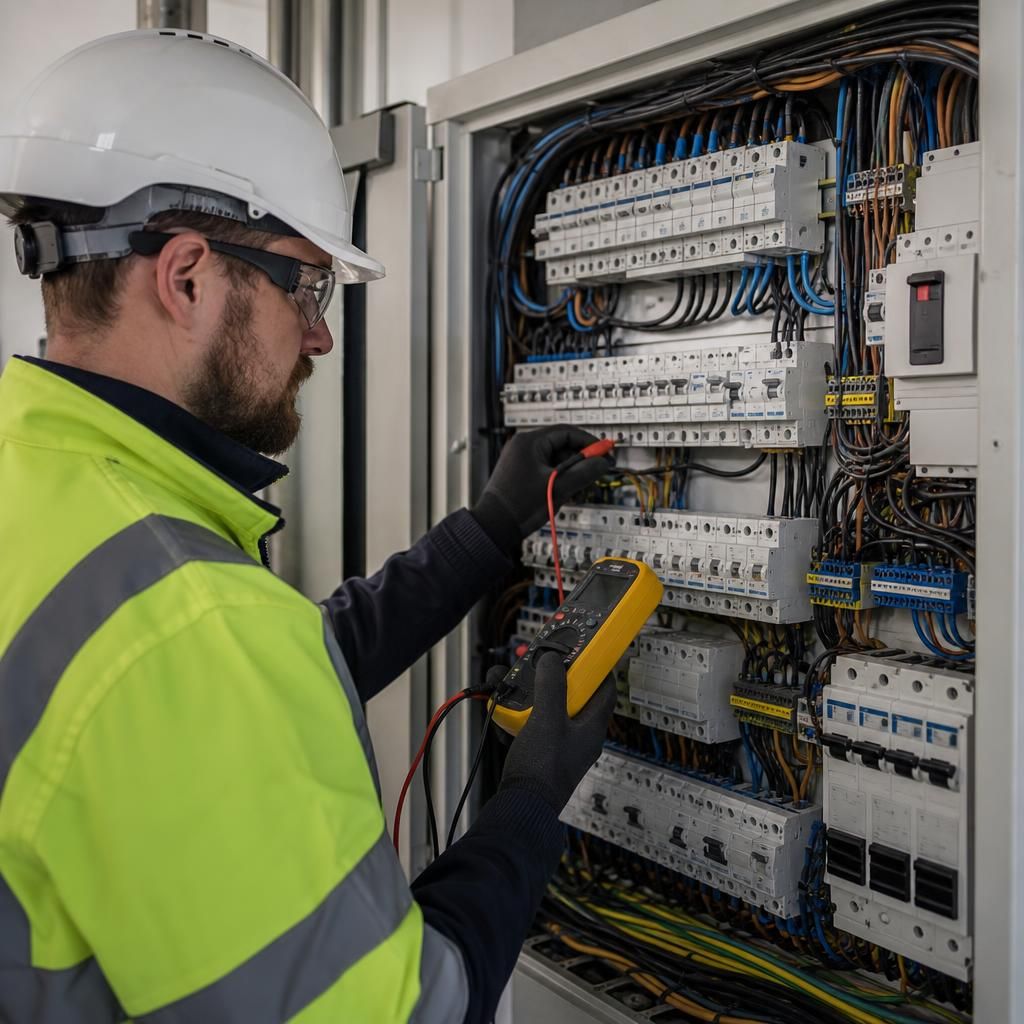
Electrical maintenance priorities should account for dependencies between systems, not only the equipment showing a fault. A problem within an upstream distribution board, isolator or supply circuit may affect several downstream services, including lighting, ventilation, communications or security equipment.
Mapping these dependencies helps the maintenance team understand the wider consequence of a failure and plan isolation safely. It also prevents attention being limited to the first failed item when the underlying issue may be located elsewhere in the electrical distribution system.
Discuss your commercial electrical maintenance priorities
If you need help reviewing a commercial electrical maintenance plan or prioritising outstanding work, discuss the building’s requirements with RJW Electrical. The team can advise on suitable inspection, testing and remedial steps, with a no call out fee quote available.