

RJW Electrical
What protective devices should a commercial distribution board include?
A commercial distribution board should typically include a main switch or isolator, circuit protection such as MCBs or RCBOs, and suitable RCD protection where required. Surge protective devices may also be needed, while the final selection depends on the installation design, equipment, earthing arrangement and the risks identified through inspection and assessment.
Protective devices in a commercial distribution board should provide isolation, overcurrent protection, earth-leakage protection and, where the risk assessment requires it, protection against transient overvoltage. The correct combination is determined by the supply arrangement, prospective fault current, earthing system, circuit loads, cable sizes, equipment manufacturers’ requirements and the type of premises.
Main switch or switch-disconnector: The board should have a clearly identified means of isolating the circuits it supplies. This allows the installation to be safely disconnected for inspection, maintenance or an emergency. The device must be suitable for the board’s current rating and number of phases. In larger installations, the incoming device may be an MCCB or another circuit-breaker that combines isolation with adjustable overcurrent protection.
Overcurrent protection: Every outgoing circuit needs protection against overload and short-circuit current. The protective device must be matched to the cable’s current-carrying capacity and the expected load. Common options include:
- MCBs: These protect individual circuits against overload and short circuits. Their trip characteristics and ratings must suit the connected equipment and the type of load, rather than being selected solely according to the circuit’s normal operating current.
- RCBOs: These combine overcurrent protection and residual-current protection for an individual circuit. They can limit the effect of a fault to one circuit, which may be preferable in commercial premises where unwanted loss of power to several circuits would disrupt equipment or operations.
- MCCBs: These are often used where circuits carry higher currents or where adjustable protection and greater breaking capacity are needed. They may be appropriate as an incoming device or for substantial submains and distribution circuits.
The device’s breaking capacity must be at least sufficient for the prospective fault current at its point of installation. A device that is correctly rated for normal load current may still be unsuitable if it cannot safely interrupt the maximum fault current available from the supply.
Residual current protection: RCD protection detects an imbalance between current flowing out through the live conductors and current returning through the neutral. This can indicate current flowing to earth. Its arrangement depends on the installation design: a board may use a main RCD, individual RCBOs, or another compliant configuration. Individual RCBOs can reduce nuisance tripping across unrelated circuits, while a shared RCD requires careful circuit grouping and fault investigation.
RCD selection also includes the device’s residual operating current, time characteristics and waveform type. Type A devices are commonly considered for circuits supplying modern electronic equipment, but equipment containing smooth direct current components, variable-speed drives or specialist power electronics may require a different arrangement. The manufacturer’s instructions and the characteristics of the connected load should be checked before selecting the device. RCD protection is not a substitute for sound earthing, bonding, insulation or overcurrent protection.
Surge protective devices: An SPD may be required to reduce the risk of damage caused by transient overvoltages from atmospheric activity or switching events. The need for protection depends on the building, incoming services, electrical equipment, consequences of damage and the outcome of the design risk assessment. Where an SPD is installed, its type, connection arrangement, backup overcurrent protection and status indication must be suitable for the system. A visual status indicator should be checked during inspection because an SPD can reach the end of its serviceable condition without interrupting the supply in the same way as an MCB.
Arc fault detection: AFDDs are not a universal requirement for every commercial board, but they may be considered for particular circuits or higher-risk premises. They are designed to detect certain dangerous arcing conditions that conventional overcurrent devices may not identify promptly. Their use depends on the installation’s risk assessment, the type of building and the applicable requirements for the project.
Protection for specialist loads: Commercial boards often supply equipment with starting currents, electronic controls or continuous operation. Motors, refrigeration, heating systems, lifts, data equipment, machinery and EV charging equipment may each require specific protective arrangements. These can include suitably selected circuit-breakers, local isolation, residual-current protection that is compatible with the equipment and protection against direct-current leakage where specified. The device should be selected from the equipment documentation and the complete circuit design, not from the board schedule alone.
Coordination between devices: Protective devices should work together in a controlled sequence. Selectivity, sometimes called discrimination, aims to ensure that a fault on an outgoing circuit operates that circuit’s protection before an upstream device disconnects a wider part of the installation. This requires comparison of device ratings, time-current characteristics, fault levels and manufacturer data. Back-up or cascading arrangements may also be used where permitted by the device manufacturer.
Three-phase commercial boards need additional consideration. Loads should be distributed between phases to avoid unnecessary imbalance, while neutral conductors must be correctly sized and protected for the expected current, including harmonic currents from electronic equipment. The board must also be compatible with the earthing arrangement and the method used to disconnect the supply under fault conditions.
Physical and identification requirements: Protective devices are only effective when installed in an enclosure suitable for the environment and the expected operating conditions. The board should provide adequate space, appropriate busbar arrangements, secure terminations, and protection against contact with live parts. Circuits should be clearly labelled, including their destination and the device protecting them. A current schedule should reflect the actual installation rather than an assumed or outdated layout.
Verification and maintenance: Before a commercial distribution board is put into service, the installation should be inspected and tested in accordance with the applicable requirements of BS 7671. Verification can include continuity of protective conductors, insulation resistance, polarity, earth fault loop impedance, prospective fault current and RCD operation. SPDs, interlocks and switching functions should also be checked where installed. Existing boards should be reviewed after alterations, changes in equipment or reports of repeated tripping, overheating or damage.
There is therefore no single protective-device schedule that suits every commercial distribution board. A competent design should document the supply characteristics, circuit demands, cable capacities, fault protection, RCD and SPD requirements, device coordination and test results. RJW Electrical can assess these factors as part of commercial electrical installation, inspection and testing work, with the final specification based on the particular premises and installation.
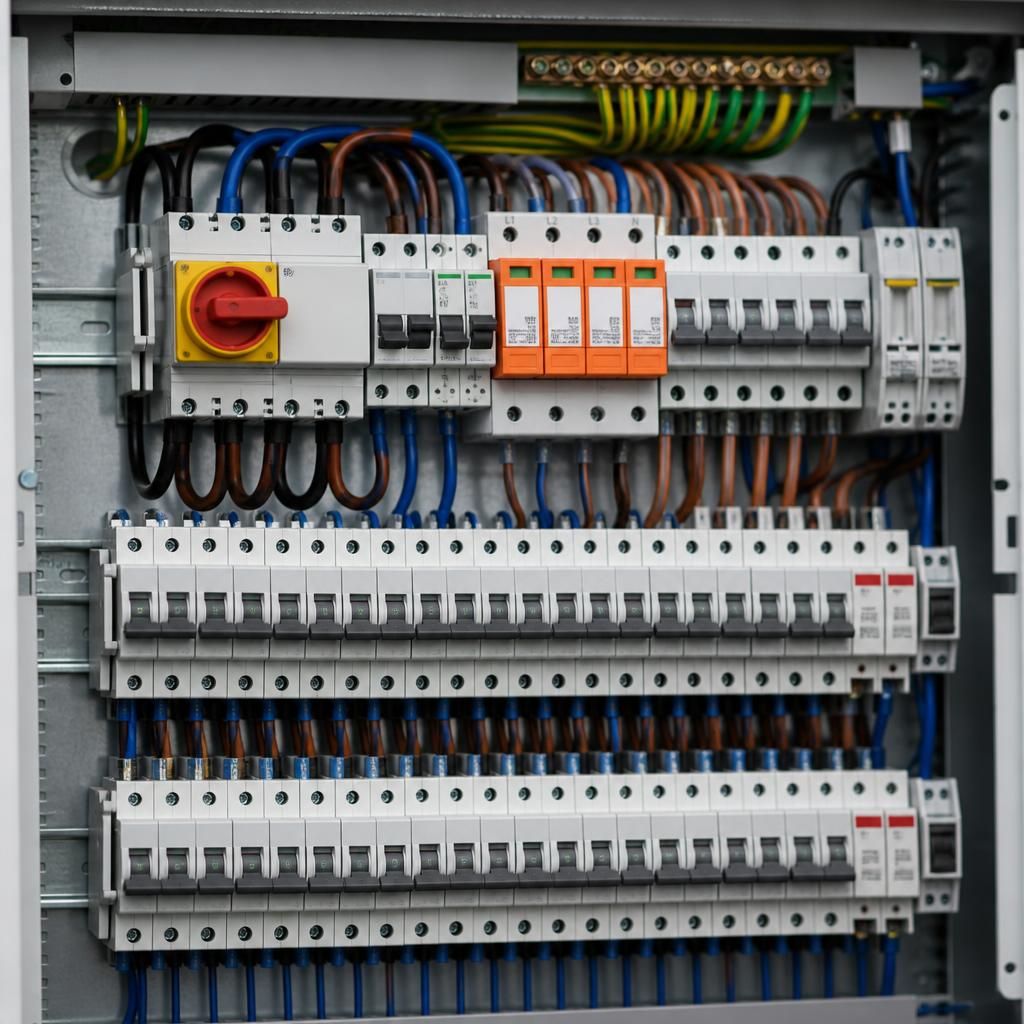
A protective device must be compatible with the complete commercial distribution board assembly, not simply fit the available space. The board manufacturer’s instructions should be checked for approved device types, busbar connections, enclosure ratings, terminal capacities and the assembly’s short-circuit withstand capability.
This is particularly important when adding devices to an existing board. A replacement breaker may have the correct current rating but still be unsuitable if it is incompatible with the busbar system, cannot be securely terminated or changes the tested characteristics of the assembly. Any alteration should be assessed as part of the complete board and recorded in the circuit schedule.
Discuss your commercial distribution board requirements
Discuss your commercial distribution board requirements with RJW Electrical to identify the appropriate protective-device arrangement for your premises. Request a no-call-out-fee quote based on your existing installation, equipment and planned electrical demands.